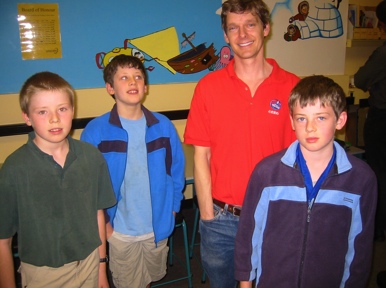
Left-to-Right: David (11), Matthew (10), Professor Chris, and Philip (9)
Professor Chris Rogers, from Tufts University in Medford MA, was in New Zealand for some sessions on robots and engineering. There was a general session on Thursday night, and I took my 3 oldest boys. Eric Mack will be pleased to know that Chris was using a MacBook Air (“Yes, it really is light, and Yes, it really does fit in an envelope”) … and he had an iPhone in his pocket. He and his colleagues have been working with Lego for about 10 years, trying to engage kids better in the classroom with the concepts of maths and engineering.
He showed some robots and videos of robots:
– the Gravity Walker from Cornell. Shows that your body is made to use very little energy except when you are going up hill or steeply downhill.
– there are many different ways of building a robot to move forward when you have the same base components
– MicroRobots from ETH, that can be injected into the eye and measure oxygen. Or can drive a robot into a blood vessel, drive up to a cancer cell, and then explode the robot and the cancer.
– robots that can be controlled by a fruit fly.
– playing soccer with very micro robots. One of the big challenges is that you need to work out how to actuate very small robots.
About 15 years ago, Chirs and a colleague started the Engineering Educational Outreach program. Key programs: outreach programs, tool and content development, a PhD programme, and for-fee programs (“So we can buy the latest laptops”, he quipped). They interact directly with about 1,000 teachers each year, and indirectly with 60,000 or so teachers, and up to about 5,000,000 students. In China, some children were working on assistive technologies. In Germany, some students built a dancing robot. Chris particularly likes seeing the interest and passion that the children bring to the classroom.
Chris says that there are 5 key teaching goals, starting with encouraging curiosity, going through to learning how to learn. (I missed the others)
What’s the difference between and engineer and a scientist? The engineer basically wants the right answer to solve a problem; the scientist wants to know for the sake of knowing. Eg, Pi is “3” for an engineer (“that’s good enough”), but a scientist wants to go to many decimal places.
Start teaching engineering as early as possible … the younger the better. Leverage their curiosity and teach them maths and science.
Wants to move the kindergarton ideas of hands-on learning into the higher levels of education.
How do we teach things in engineering:
– there is a gender difference, in general. Boys are competitive, girls are cooperative. Boys want the details, girls want to see the big picture. Boys want to work alone and argue nothing, girls like to work in groups.
Teaching building:
– structurally sound building
– 1st Grade maths, for teaching decimals by building a robot to drive to a certain place … but it requires 1.6 seconds, not 1 or 2.
– 3rd Grade maths, for time vs. distance, to stop a vehicle before hitting a Lego person
– at College level, control theory.
– 9th Grade physics, for calculating G
– 9th Grade Physics, for projectile motions
– 9th Grade Physics, with Vernier Sensors
– develop a Lego-driven fax machine
– get students to go into classrooms and help the teacher with teaching engineering
Why is all of this not taught in the classroom? It’s a different teaching style (coaching), there is no right answer, it takes longer so you cover less, the content knowledge is not taught in pre-college schools, and it requires teaching through chaos.
Thus to make this happen, they are building a community of teachers to do all of this, available at LEGOengineering.com. Teachers can share what they are doing with robotics with others.
It was a great session … there were about 50 people in attendance, and of these about 20 were under the age of 18.
Categories: Michael's Happenings
 Michael Sampson