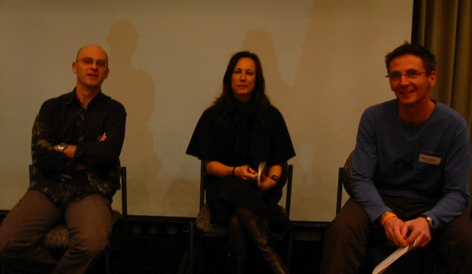
David Archibald, Cairo Walker, Dorje McKinnon
David Archibald, IRL
(1) biggest driver is around records management, not information management.
(2) there is a lot more talk about communities.
Cairo Walker, Step Two
– 2010 isn’t too far away.
– Key theme: purists vs. pragmatists. We’ve seen and will continue to see vendor offerings with an all encompassing approach.
– “ECM” … what exactly does this mean for organizations? Much exploration to happen in this space.
– Open source is coming into the light.
Dorje McKinnon, Sungard AvantGard
– If you have a strong executive sponsor, they’ll drive for the 100-page strategy and six year strategy. Few organizations don’t suffer from such bad ideas.
– Many organizations have something in place already. Too difficult to just throw things out. Will evolve over time, with new applications bolted on.
– We’ve got a lot of work to do on training and advocacy.
– The ongoing nature of Intranets means that we’ll all do something, and achieve things … unsure whether the big platforms are going to work or not.
Comments and Questions from the Floor
1. (Robyn) How do we get our organization to shift from limited access to open access? Eg, editing rights on wikis.
(David) This is the case in our organization.
(Cairo) Ask questions about what the risks are around certain items. Define these.
(Dorje) One way to mitigate this risk, is to ask who they think will go to the site and see the information. And then show them who actually is (everyone is really busy already).
2. How many people have a formal document management system? And for those that don’t, can the Intranet become that?
(Audience) About 60% of hands went up for part 1, and similar numbers for part 2.
(David) How many are worried about the compliance with the Public Records Act by 2010? (Audience) Lots of hands up.
(Commenter) Perhaps the Intranet will become an interface to the document management system.
(Commenter) It’s about unlocking the existing stuff. We have a lot of things today. How do we provide the best interface across this?
(Dorje) I’ve got 10 people that provide third-line software support. How do they manage their information? Answer … were using Internet Explorer Favorites to add File Share links. Then shared those links among themselves.
3. (Julian) Has Australia has the same issues with Public Records?
(Cairo) We have, but I haven’t played in that space.
(David) It depends on the organization. Many intranet managers will see their time sucked up into records management initiatives, rather than intranet ones.
4. (Stuart) What about communities that aren’t tied to “desktops”? What about mobility?
(David) Many of our staff work in labs, not at their desktop. How do we provide access to information at the lab level?
(Cairo) Seeing customers with a demand for this. But little maturity exists. Some organizations are piloting this type of material. Some of the information requirements are very task specific, depending on the person’s role.
(Dorje) Many executives have BlackBerries — really like wireless email. Most staff are tied to their desktops … but there are other organizations that are giving out small form factor devices for access to this. Another route is to provide access from home.
5. (A comment) I’ve spent two thirds of my working life on marketing and advertising, and the last third with an IT company. The drivers for intranet solutions often come from communications or IT. The drivers get the ownership, and perhaps these groups don’t get enough stakeholder involvement from the other groups. Argues that IT need to be included in the discussions earlier rather than later — eg, what technologies are they willing to support?
(Dorje) Absolutely agree. Once requirements are known, the next thing is to ask IT whether they’ll play or not.
(David) I had a GM a few years ago of Knowledge Management. Was given a job review, and was said to be “too collaborative”. Ironic.
6. We are in a fairly disasterous situation. How do we get availability for consultation from everyone here? Please give us your business card.
(Julian) There are two ways to access support … ask consultants (“I’m one of them”), there are solutions providers (eg, Provoke, Datacom) … and there’s also the Kiwi Intranets forum and the Intranet Leadership Forum.
(Commenter) Our organization hasn’t signed off on budget for joining things like the Intranet Leadership Forum.
(Julian) The Kiwi Intranets Forum is free. Perhaps then leverage up to the Intranet Leadership Forum.
(Dorje) I’d welcome any of the consultants / providers to contribute to the Kiwi Intranets discussion group. It will help with relationship development for future business opportunities.
(David) Ring up other people, and ask to go and see their intranets. It doesn’t cost very much.
7. (Emma) We’ve talked a lot about not asking people what they want, but instead to discover what their needs are. When I think about doing it, it seems very time consuming.
(Cairo) Have done lots of these. Can do a whole organization in 3-5 days … you can map out the roles fairly quickly. You can’t talk to everyone, but you’ll see common themes. After 15-20 interviews, you’ve got pretty much everything. Watch what they do (“hang out in the crew room”).
(Mark) We don’t try to get everything 100% with all of the user groups; we take it to 80%, and implement the core. Give the first prototype, and then look at iterative improvements.
(Cairo) One of the things I do with the needs analysis, is to reflect back the findings to the group. Set it up as a work-in-progress session, so people there can give corrections and further ideas.
(Cairo) The analysis phase will take 3-5 days.
(Cairo) Good to play direct quotes back to the people.
(Julian) Rather than “asking users what they want”, go and interview them in their offices and ask them to show you what they do. You can tell a lot about the person by their information management and seeking styles.
(Philippa) We didn’t have money to talk to our users. We used a program called VNC (screen sharing) to see desktops remotely. Helpful and useful. Often people did on the screen what was entirely different from what they were saying.
(Cairo) Go and work in various roles for a while, and learn first-hand.
(Julian) Much of this thinking on information architecture has come from cultural anthropology, because you are changing the system when you ask.
(Commenter) Getting a stake in the ground and get it out there, can be another place to start. You’ll get feedback.
8. (Ken) At TechEd, one of the presenters said he got very “scared” when people talk about “re-designing” the Intranet. Is that a good place to be?
(David) We’ve just gone through a re-launch into a CMS … we split the design for the communications people, and kept the technical work. Seems to work well. It’s just a natural part of the evolutionary process.
(Cairo) Most redesigns start from “we know it’s not working, so let’s fix it … and the view that if we throw more technology at it, we’ll solve the problems. Hey, the vendors know more now”. But this is a poor methodology. Taking a journey approach over 3-4 years is good … iterative development.
(Dorje) In our case, we papered over the cracks. We made things easier to find and use. Immediate impact: we had happier users. From a purist perspective, felt that he had too many constraints on his actions.
(David) We used to have regular surveys, but too much change drives dissatisfaction.
(Commenter) “Stop moving things around” … because even if it’s in a dumb place, people will learn where it is. People get used to dumb positioning.
Categories: Conference Notes
 Michael Sampson