Steve introduced the fourth speaker of the day, and the first one after the morning break. Martin De Beer from Cisco Systems is talking about how video and web 2.0 are changing the enterprise.
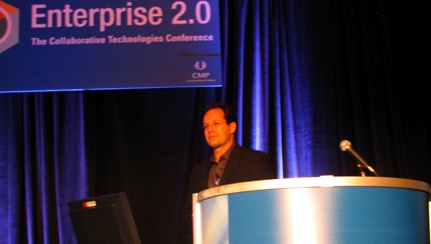
Martin’s point of view:
- The face of things to come … the next generation uses Web 2.0 tools like flickr, Pandora, facebook, and YouTube. They’ll expect these things in the enterprise, just like we expect email to be there.
- Web 2.0 is a technology in transition … with user participants (they define the content and write it), social networks (no longer social networking use email, but rather social networking tools and sites for mass collaboration), programmability, and mashups. Martin says that at Cisco they have a Web 2.0 style site for submitting ideas for mass collaboration and coordination, and after 9 months of usage, they have $400 billion (?) market ideas.
- Our unique personas are blending, driven primarily by changes in technology. The concept of an application is turned on its head, and becomes an end-point. At the new center is the user … as a professional, an individual, etc. We need to interact in multiple ways, over many disparate networks, but the distinctions on the networks are changing. Anytime, anywhere access is a given. Applications were segmented between enterprise applications and public web applications, but they are merging today.
- The web is changing, from a site to visit (a “destination”) that you needed to know where to go. It was structured and managed. In the Web 2.0 world, the site is created by the community, and although you still need to know the destination to go to, it is open and unmanaged. Another possible step is peer-to-peer, where the network is the destination, and you only need to know what you are looking for. This too is open and unmanaged, eg, shared music.
- Another fascinating change is the power that we can hold in our hands for creating, publishing and sharing content with others. HD video cameras are powerful and relatively cheap. Cellphones are increasing very powerful. Consumer TelePresence is coming for installation in the home (within 2 years, says Martin).
- Video will increasingly become a very important part of Web 2.0 and mass collaboration in general. Historically, there were disparate market segments for video collaboration, but these are now converging. A picture (still shot) tells a thousand words, but a video tells it all. Web 1.0 was about browser, email and IM. Web 2.0 is about wikis, blogs and mashups. The future belongs to video … any media, anywhere, any time. This will create a whole new wave of applications.
- TelePresence is currently priced for business setups … but it will become cost-effective for deployment in the home for virtual meetings between geographically distributed family members. This will become possible across a range of devices.
- Cisco has seen tremendous success with TelePresence inside. It has 100 sites of TelePresence, and in the first 12 (?) months, have had 12,000 meetings that otherwise would not have happened. They are seeing sales cycles declining, and other processes being sped up. Nice case study.
Collaboration is the biggest application of the network going forward. More and more intelligence is being added into the network, and video will be a key and essential component of this.
Categories: Conference Notes
 Michael Sampson